A children's book series about robots
An interview with author Eva Leurink, who explains why this is necessary.
Late last year, she successfully completed a crowdfunding campaign that will enable her to publish her first children’s book about robots. Eva Leurink, a technological innovation advisor at Kennisnet and also a writer, believes it’s important for children to be introduced to robots and artificial intelligence at a young age—and that they not only learn to use the technology but also gain a basic understanding of how it works. This will help them make the right choices when applying the technology later in life. Enthusiasm and interest must prepare the next generation for a world full of technology. In an interview I had with her, Eva explained why she believes this and how her book will contribute to that goal.
A general question to start with: what’s your take on robots?
What I really love about robots is that they’re so incredibly diverse and that they can lend a hand in absolutely every sector. And I find developments in the field of robotics truly fascinating. Whereas they used to be kept safely in large cages in a huge factory hall, where you could barely see them, they’re now coming closer and closer. On the streets with self-driving cars, but also in our homes with robotic lawn mowers or robotic vacuum cleaners.
There are also major developments in the field of social robotics. People are working hard to make robots more and more human-like. I do wonder, though, if I really think that’s all that desirable. I think it’s important that we continue to be able to distinguish between humans and machines. It is, however, a very interesting development, and things are moving quite fast right now—both in terms of hardware and software.
On LinkedIn, I read: “Let’s get children excited about robots and AI and prepare them for a future with robots and AI.” What should they be prepared for, and why should they be made enthusiastic about it?
I think it’s very important that people—and therefore children as well—can continue to distinguish between humans and machines. A robot shouldn’t replace a human. I think the added value of a robot lies elsewhere—for example, in performing repetitive tasks or helping with things we don’t particularly enjoy doing. But robots are starting to look more and more like humans, including in the way they speak. I’m concerned about this for children. Will they still be able to tell the difference between a human and a robot? Do they understand how it works—that there’s input, a process takes place, and output results? And that it’s not always transparent what’s actually happening. I think it’s important for children to know this because they’ll be using this technology extensively in the future. AI is actually already embedded everywhere in our society. I fear that will only increase. And I say “I fear” because we didn’t ask for it. It’s a technology being rolled out everywhere without anyone ever having really thoroughly researched its consequences. We weren’t asked at all if we even wanted this, and yet it’s already everywhere—and it’s only going to become more prevalent. The driving forces behind all of this are those big tech companies that don’t prioritize children’s well-being at all. I find that very concerning.
The reason I think it’s important for children to get excited about this is the same. You can’t ignore it anymore. So if children are at least a little interested in the technology behind it, hopefully they’ll understand it too. How do you design a robot, how do you program and assemble something like that? The same goes for AI—how does it actually work? And if they’re interested in it, I hope they’ll delve deeper into it. Then, when they go on to design a robot, they’ll hopefully do so with a goal in mind that’s at least good for the world. It’s important to understand the basics of the technology. We mustn’t lose sight of that. Because with those language models, you can already generate code.
It sounds like you think children should learn this anyway, without having to read your book. Is that correct?
Absolutely. I see it as part of digital literacy. It’s a component of digital literacy that you need to function as an independent, critical citizen in this society. To do that well, you need basic skills—language skills, math skills. Those are extremely important skills, but digital skills are just as important, because technology is already profoundly impacting every aspect of our lives and influencing us. You need to understand how that happens. Robotics and AI are part of that.
Why did you start a children’s book series about robotics? The idea came to me 5 years ago when my daughter was born. My husband and I were both working in the robotics field at the time, and we received a little book about robotics for babies. It was a really cool gift, but we just didn’t think the book was actually about robotics—it was more about automation. And then I thought, does such a thing even exist—a book that simply explains how robots work? I discovered that nothing like that existed for a young audience, so I decided to just write it myself. Over a beer, I came up with the characters. Then the pandemic hit, and the book got put on the back burner. A year ago, my second daughter was born, and that’s when I decided it was finally time to get it done—because now I have two daughters growing up with robots.
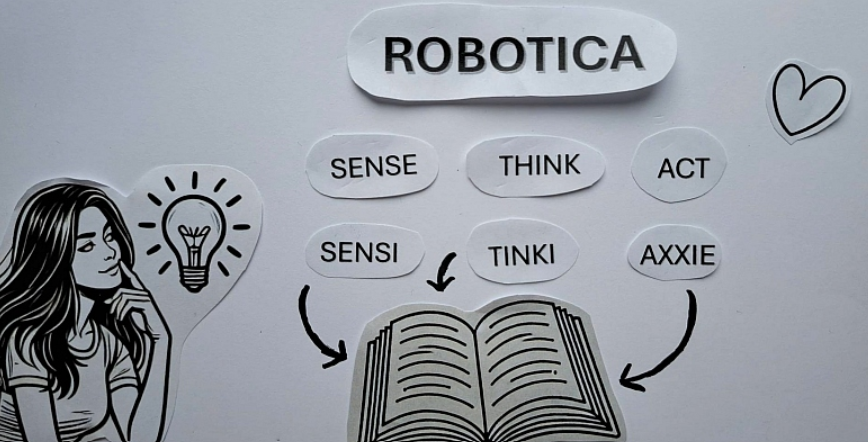
If you really want to explain what robotics is, you have to explain its basic principles. Those are “sense,” “think,” and “act.” I turned those into characters: Sensi, Tinki, and Axxi. Sensi takes center stage in the first book. The robots work in a book factory. But Sensi has a dream: to work in a much more fun candy factory. The robot tries to escape with Tinki and Axxi, but it’s not that easy. There are dangers everywhere in the factory, and robots can’t just do new things, like climbing stairs. They have to learn that first.
The second book focuses on Tinki. The robots discover that they can’t just start working at another factory right away. They’ll have to go back to school first. The book explains how robots “learn” using machine learning.
The third book focuses on Axxi. The robot wants new grippers and has them made at a hospital where 3D printers act as doctors. The book explains what robots look like on the inside and how they receive new parts, for example.
In the fourth book, children discover which careers suit each character and learn that everyone has their own talent—whether it’s something from Sensi, Tinki, or Axxi. No stereotypes—just discovering what they enjoy and what they’re good at.
What I really like is that the robots in the three stories keep learning a little more each time. They’re evolving. The idea is for it to be a kind of picture book. And I specifically don’t want robots that look like humanoid robots or that resemble humans at all. The target audience is young—children around 5 to 7 years old. The books are fun, educational storybooks.
When will your book be available in stores?
Hopefully this year, but it might take a little longer. The first steps have been taken!
Children's Book: Robotics & AI by Eva Leurink
Source: Techguilt.nl